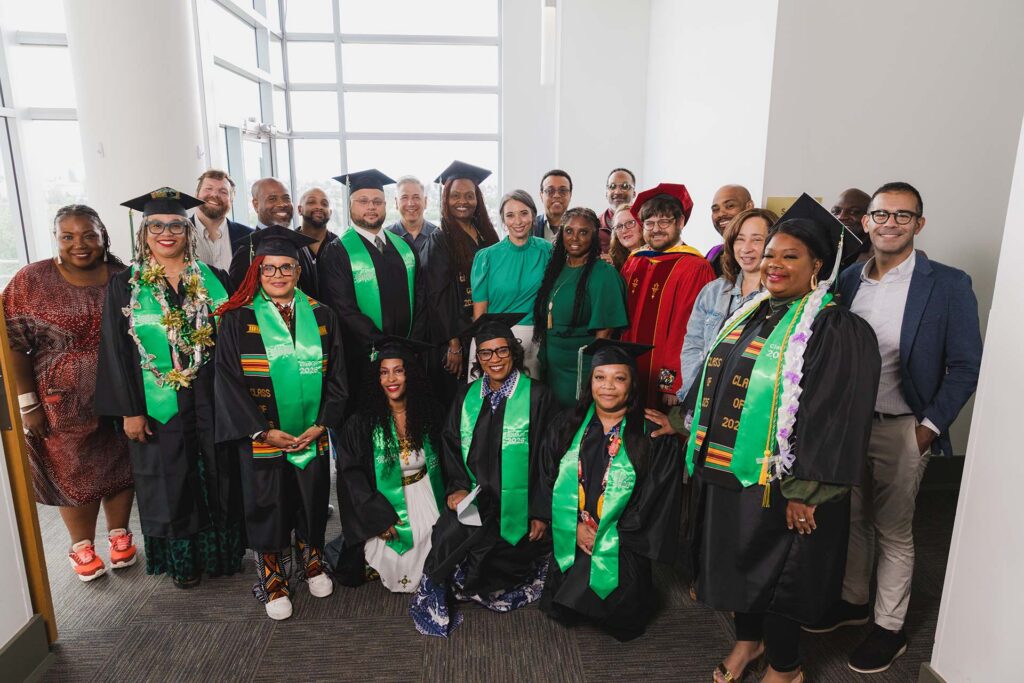
College Unbound believes higher education should be designed around the realities of students’ lives—not the other way around.
For adults balancing work, family, and community responsibilities, traditional college often creates barriers rather than opportunity. CU has built a different model: one that recognizes the knowledge students already possess, centers relationships, and supports learners as whole people.
This is what higher education can look like when it is designed for real life.
Since accreditation in 2020, College Unbound has grown from 100 to more than 600 students across seven states with a validated model that works for adults. By recognizing lived experience and offering tailored support, CU delivers transformational outcomes for working adults. Now, with proven results behind us, we are poised to scale this model nationally and extend opportunity to learners across the country.
Average age of student
of those enrolled are first-generation college students
CU’s retention rate for the Fall 2024-Spring 2025 period
Time that most students graduate
Community ambassador guides prospective students through their journey into CU.
From first one-on-one meeting, students begin designing their projects.
REQUIRED COURSES:
REQUIRED COURSES:
ELECTIVE COURSES to meet requirements of the major:
REQUIRED COURSES:
Workplace & World Lab
CU Core Project: a student- initiated, real-world initiative that serves as the central focus of a student’s bachelor’s degree. All coursework and learning at College Unbound directly support the development, research, and implementation of this practical project.
Wraparound Support: academic and technology support, basic needs, mental health, career advising, meals and child- watch.
Big 10 Transformational Leadership and Change competencies.
One-on-one meetings with faculty for every class.
120 credits required, 30 credits through CU requirements and 10 credits through required Big 10. Students can transfer up to 90 credits including up to 40 through LIP.
Community ambassador guides prospective students through their journey into CU.
From first one-on-one meeting, students begin designing their projects.
REQUIRED COURSES:
Unbound Journey
Reframing Failure
Intro to Organizational Leadership & Change
Workplace & World Lab A
REQUIRED COURSES:
Learning for Experience
Research Justice
Writing for Change
ELECTIVE COURSES to meet requirements of the major:
Big 10 portfolio submission
LIP portfolio submission
REQUIRED COURSES:
Workplace & World Lab Z
Capstone
Workplace & World Lab
CU Core Project: a student- initiated, real-world initiative that serves as the central focus of a student’s bachelor’s degree. All coursework and learning at College Unbound directly support the development, research, and implementation of this practical project.
Wraparound Support: academic and technology support, basic needs, mental health, career advising, meals and child- watch.
Big 10 Transformational Leadership and Change competencies.
One-on-one meetings with faculty for every class.
120 credits required, 30 credits through CU requirements and 10 credits through required Big 10. Students can transfer up to 90 credits including up to 40 through LIP.
What sets College Unbound apart is a combination of six elements that, together, create a fundamentally different and more accommodating higher education experience.
Together these elements create a model that is uniquely effective and uniquely scalable.
Most students receive a life-changing degree within 2.5 years.
A student’s “personal learning network” comprised of lab faculty/advisor, alumni mentor, and peers
Every student is known, supported, and encouraged through meaningful one-on-one relationships from enrollment through graduation.
Low tuition, paired with financial education, limits student debt
Credit earned through Learning In Public (LIP) portfolios show- casing prior knowledge and lived experience
Academic support, technology/ support, assistance in college readiness, providing childcare, etc.
Students complete CU at their own pace, some choosing to complete in four years, while others accelerate and graduate in as little as three semesters, just over one year.
The goal is not simply to graduate faster; it is to graduate prepared with the confidence, perspective, and leadership skills to move through the world differently.
Earning my degree has opened doors, I once thought were out of reach. It strengthened my confidence, expanded my career opportunities, and showed my family what perseverance looks like. It didn’t just change my future; it changed how I see myself.
-Fanisha Terry, Washington (Class of 2026)
My previous experiences in traditional educational settings often felt isolating and, at times, impossible. At College Unbound, you’re seen, heard, and challenged to grow. There’s a real sense of community, and no one cheers you on harder than a CU cohort peer.
-Josselyn Velasquez, Rhode Island
At College Unbound, students never navigate their journey alone. Every learner becomes part of a cohort, a close-knit group of peers who start together and stay together.
At College Unbound, every interaction is designed to ensure students are known, supported, and encouraged.
College Unbound saw me as a person before they saw me as a student. They met me where I was, believed in me even when I doubted myself, and gave me the support, encouragement, and community I needed to keep going.
-Ayanna Wells, South Carolina (Class of 2026)
For too many students, the cost of higher education isn’t just a challenge—it’s a stopping point. College Unbound was built to change that. With intentionally low, transparent tuition (and access to financial aid, scholarships, and employer support), students are able to pursue their degrees without taking on overwhelming debt.
of CU students have received Pell Grants
CU values and credits the learning from our students’ lived experiences. Their required second semester class, Learning for Experience, teaches the documentation process so that all students can complete LIP. Through Learning In Public (LIP) portfolios, students document and reflect on the knowledge they’ve gained.
The result is seismic; not only do students earn credit, they recognize the value of their lived experience.
can be earned through LIP, with 10 credits required through the Big 10 Transformational Leadership & Change competencies
of students earn LIP credits beyond the Big 10
credits on average earned through LIP
of graduates report a greater belief in their potential by reflecting on their accomplishments
Earning my degree has changed my life by making me more marketable for career advancement and helped me show the importance of education to my daughters and other youth I coach and mentor.
-Anton “Ricco” Booker, South Carolina (Class of 2026)
For many students, the biggest barrier to finishing college isn’t ability; it is the challenge of meeting the many commitments to family, work
and community.
At CU, support extends beyond the classroom, recognizing that students don’t leave their lives at the door when they pursue a degree. The CU community understands what they’re balancing and is committed to helping them navigate it.
Available Supports Include:
College Unbound’s model is not theoretical. It is proven.
of students who start CU thought that the BA was no longer an option
of alumni express greater confidence in their potential after completing their degree
Alumni experience on average a $12,400+ salary increase within the first two years and $25,000 within five years
continue to graduate programs & certifications post graduation
The influence is not just on the individual student. College Unbound graduates are applying what they learn in real time, influencing workplaces, neighborhoods, and systems.
of graduates report they are more likely to advocate for others
influence friends and family to return to college
have indicated that they’re more likely to be community engaged and volunteer on behalf of their community
are driving change in their organizations
College Unbound is not just graduating students; it is catalyzing the impact of the change-makers in our communities.
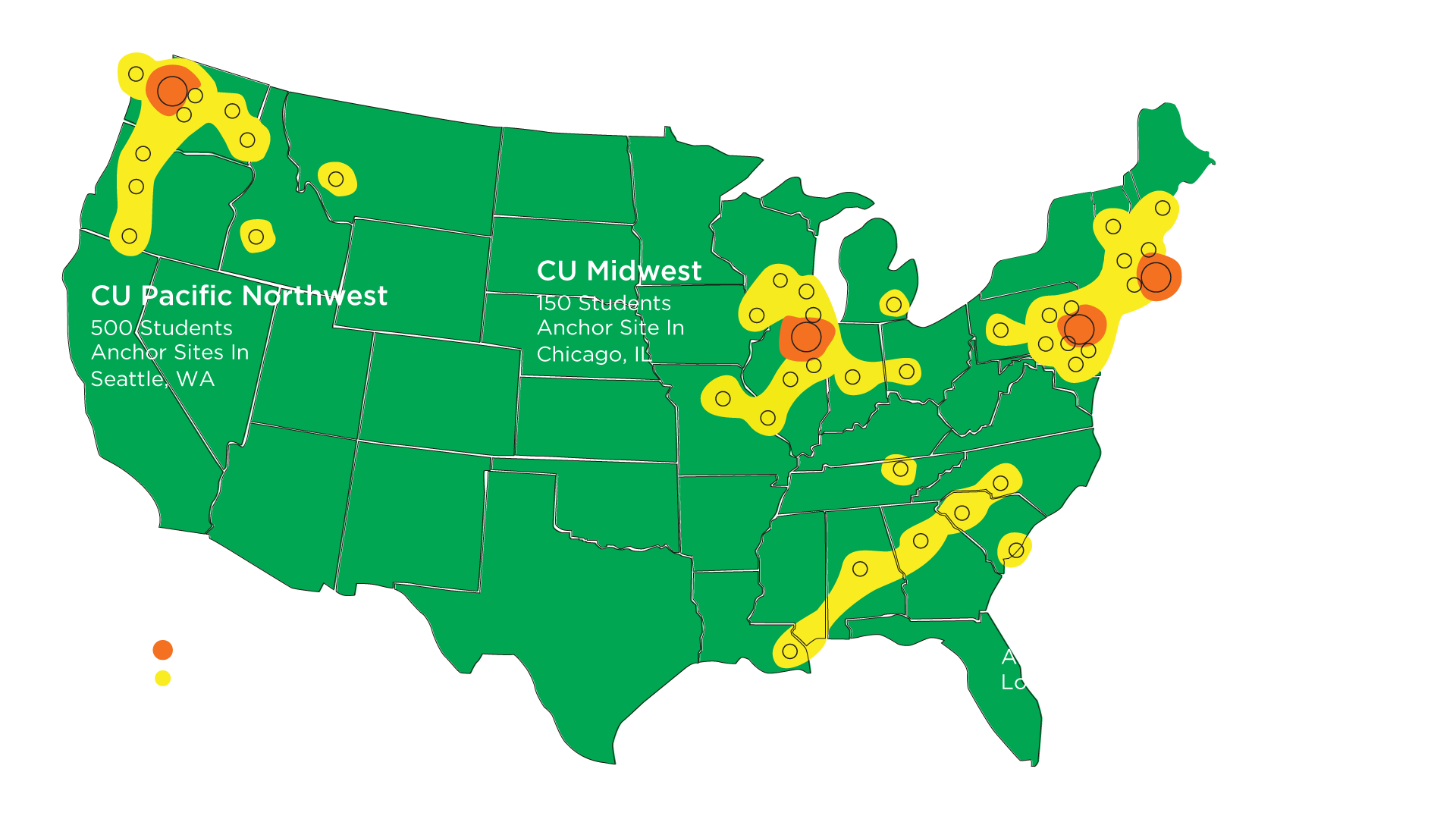
Since accreditation in 2020, CU has grown from 100 students in Rhode Island to more than 600 in seven cities in five years.
Over the next five years, College Unbound is poised to expand into five regions across the country, building a national network that maintains deep local connections. This growth will allow the college to serve nearly 3,000 students, tripling its reach and dramatically expanding its impact.
We must achieve this growth while preserving the elements that differentiate CU from other colleges, and investing in the infrastructure, technology and people that will allow us to deepen our commitment to our students.
This next phase of growth is both ambitious and intentional.
College Unbound will:
A centralized national office will ensure consistency, quality, and shared learning across all regions. This structure allows College Unbound to scale without losing what makes it powerful: its community and connection.
For the stressful and demanding field of Community Violence Intervention which is built on the work mostly of community members who were excluded in one way or another from education and opportunities, a tailored, cohort-based college experience is vital for them to regain their footing in the workplace and open stable career and promotion horizons.
-Teny Gross, Institute for Nonviolence Chicago, Chief Executive Officer
We invite you to invest in the futures of individual students. Support a cohort. Ensure Learning in Public credit remains free and accessible to all students. Help expand the Prison Education Program to a new region.
Your investment creates ripple effects across families, workplaces, and communities, expanding economic opportunity, strengthening local leadership, and opening doors for future generations.
At its core, this work is about creating a different future for higher education: one that is more holistic, more flexible, and more responsive to the realities of people’s lives.
Because this is not simply about helping more people earn degrees. It is about building a system worthy of the lives they already lead and empowering graduates to use their knowledge, experiences, and leadership to make their communities, and ultimately the world, better places for all.